
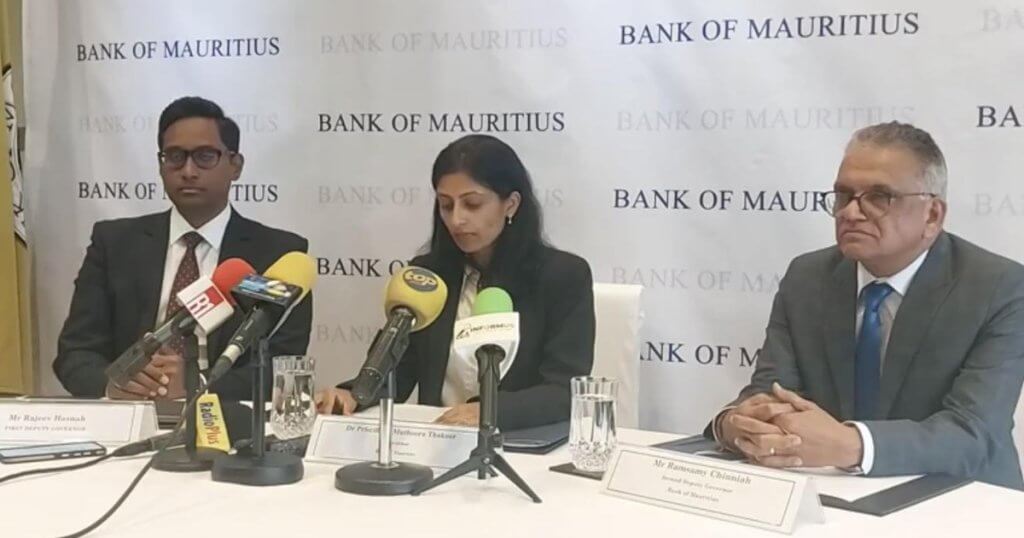
Priscilla Muthoora Thakoor tried a bold academic deflection at her post-Monetary Policy Committee press conference.
By a Financial Observer
At her post-MPC press conference of the 20th of May, the Governor of the Bank of Mauritius tried a bold academic deflection. Faced with entirely predictable questions about the explosive growth of M2 money supply and the mounting excess rupee liquidity in the banking system, she declined to answer with hard numbers. Instead, she waded into the political mud, dismissing basic macro-arithmetic as dangerous “fake news” — and directed journalists to “very serious research from the Toulouse School of Economics” as proof that such commentary destabilizes business cycles.
There is one minor problem: whoever skimmed the paper for her briefing notes clearly stopped at the headline.
The Citation That Backfired
The paper in question is “From Buzz to Bust: How Fake News Shapes the Business Cycle” (TSE Working Paper 24-1516, March 2024). Two things matter immediately. First, this is a working paper — pre-publication research circulating for peer critique, not a formally reviewed or accepted study. Second, its dataset is strictly limited to the structural characteristics of the United States economy between 2007 and 2022. Presenting it as settled science applicable to a small island developing state is the first sign of desperation.
More damaging, though, is what the Governor clearly never read. The researchers explicitly categorized different types of misinformation to isolate what actually drives macroeconomic instability. Their finding on supply-side fake news — rumours about energy, technology, and taxes — was that it does create measurable business anxiety. But the very next sentence of the abstract draws a sharp line:
“On the contrary, fake news related to government finance, market regulation, or the labour market does not impact economic stability.”
A debate about a central bank’s M2 expansion, excess liquidity, and domestic sterilization framework is, by definition, a debate on government finance. The Governor’s own academic shield completely exonerates the commentary she sought to censor.
Dodging the Arithmetic
The “fake news” label also served a convenient purpose: it allowed the Governor to sidestep a glaring mathematical reality.
Between 2019 and today, Mauritius’s broad money supply expanded by roughly 80 percent — from approximately Rs 564 billion to over
Rs 1,090 billion. Over that same period, cumulative nominal GDP growth lagged far behind. Meanwhile, the Bank’s sterilization instruments — the tools designed to absorb structural excess liquidity — barely moved, edging from roughly Rs 95 billion to approximately Rs 120 billion. The rupee overhang has nearly doubled; the Bank’s absorption capacity has flatlined.
The Governor’s response to this structural imbalance? A standard 25 basis point rate hike — a cosmetic adjustment that does nothing to address the quantum of excess liquidity built up over years of monetary expansion.
Defending the Indefensible
The theatre reached its peak when the discussion turned to bank supervision. Pressed on why the Central Bank repeatedly overlooked a decade of systemic failures — from massive corporate loan write-downs to the high-profile collapse of Silver Bank — the Governor offered a striking defence: you can’t blame the central bank, just as you don’t blame the police when a crime occurs.
This analogy collapses on contact with reality. A systemic banking failure is not a sudden street mugging. It is a slow-motion, structural collapse — visible, measurable, and entirely within a regulator’s mandate to prevent. When a financial institution fails to submit audited accounts for two consecutive years, the financial police aren’t failing to stop an unexpected crime. They are asleep while the building burns.
The deeper irony sat right beside her at the press table. The newly appointed Second Deputy Governor, Ramsamy Chinniah, spent 32 years in the Bank’s Supervision Department and served as its director during the very period these regulatory failures accumulated. Rather than being held accountable, he was promoted.
That appointment, like all critical roles at the Bank, flows through Section 14 of the Bank of Mauritius Act — handed out on the recommendation of the Prime Minister, with no open recruitment, no transparent interviews, and no merit-based vetting. In practice, appointments are shaped by regional considerations, caste, and religious balancing rather than technical competence.
When an institution’s leadership is selected on tribal loyalty rather than monetary mastery, the gaps eventually surface in public — leaving the country with defensive analogies, an unaddressed liquidity crisis, and an unread academic paper turned against its own author.