
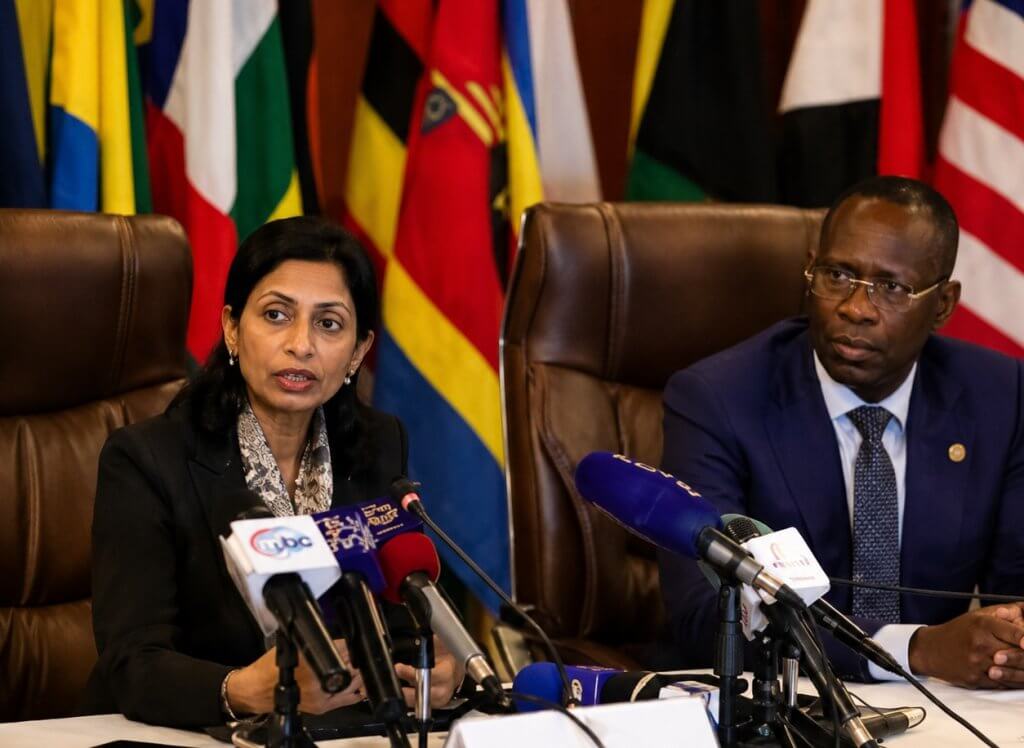
Face aux défis à la BoM, Priscilla Muthoora Thakoor assiste à des conférences internationales.
By Financial Observer
When a central bank suspects its own Board minutes have been tampered with, what it does next is the measure of its credibility. The Bank of Mauritius (BoM) — long the country’s most respected institution and the keystone of its financial centre — has answered with an internal review by an “independent cross-departmental team” from inside the Bank, due end-July 2026. The alterations allegedly date from just after the November 2024 election; twenty months on, Mauritians are still waiting. No institution can certify its own integrity while its leadership’s integrity is in question. The minutes affair is not the disease, but the latest symptom of a crisis of confidence that began with one man and now runs from the Board through senior management.
Trace the rot to its source and you arrive at the appointments that followed the 2024 election — the pivot on which the entire institution turned. Rama Sithanen became Governor alongside First Deputy Rajeev Hasnah and Second Deputy Gérard Sanspeur, the Prime Minister’s self-styled “dream team.” None had run a bank or worked in a central bank’s operational core — supervision, markets, balance-sheet or risk management. Sithanen’s main private-sector role, chairing a management company — one of the lowest-value links in the global financial chain — gave him no central-bank grounding. Central banking is a discipline of its own. It is nothing like running a metals firm, an advisory shop or a management company; those skills do not transfer, and the craft cannot be learned on arrival.
The board failed the fiduciary duty
And here the gravest governance failure begins. Mauritius sells itself on governance: its National Code of Corporate Governance demands an independent-minded board that manages conflicts and holds management to account; the Companies Act binds directors with fiduciary duties. Instead, critics argue, the board was built to nod — a rubber stamp that let a public institution run with the latitude of a private family endowment. By those very standards, the board failed the fiduciary duty it owed the people of Mauritius.
The line-up unravelled within ten months. Sanspeur resigned in August 2025, alleging political interference and naming the Governor’s son, Tevin Sithanen, as an outsider steering regulatory decisions with his father’s knowledge. Transparency Mauritius sought inquiries after recordings attributed to the son surfaced; Sithanen denied wrongdoing, and no finding of fact has been made. By late September the Prime Minister had asked him to go, and Dr Priscilla Muthoora Thakoor took over.
From there the Bank went into free fall — and Governor Thakoor cannot pull it out of the tailspin. She inherited the wreckage and kept much of the compromised crew: her First Deputy, appointed by Sithanen to chair the Mauritius Investment Corporation (MIC), still runs the fund at the centre of the storm; her Second Deputy ran supervision through its worst lapses and was promoted regardless. The directors who presided — the First Deputy Governor among them — should have resigned; instead, complicit in the institutional and nepotism crisis, they chose to stay.
A serious crime
To tamper with a central bank’s Board record, days after an election, is no clerical slip; it is potentially a serious crime. The custodian of those minutes is the Secretary to the Board, who also heads the Bank’s legal function and was herself compromised during the Sithanen period. A review by her own colleagues cannot credibly judge her: if the allegations hold, she must be taken to task.
The BoM machinery is misfiring just as badly. Years of FX intervention and the ~Rs 140 billion printed in the pandemic have left a vast monetary overhang — broad money near Rs 1 trillion, and excess liquidity the Bank cannot mop up. That excess, its own Monetary Policy Committee concedes, blunts policy transmission, feeds inflation and distorts the currency market: rate decisions fail to bite, and the foreign-exchange market seizes. Starved of liquidity, it can no longer set a credible price for the rupee — importers struggle to source dollars, dealers quote punishing spreads, and a thin, one-way market replaces a functioning one. That dysfunction is itself a daily vote of no confidence in the currency, and in the Bank that is meant to guard it. Add a balance sheet strained by an asset-liability mismatch and by MIC write-downs eating into the Special Reserve Fund — the equity buffer behind the currency — and the central bank’s core functions are failing at once: the engine of the institution, seized.
The MIC — some Rs 81 billion of printed central-bank money — remains largely un-wound. Its biggest exposure is a 49% stake in Airport Holdings Ltd. Such large, illiquid assets have no place on a central bank’s balance sheet, and the in-house team cannot unwind them. Consolidating the MIC onto the Bank’s own books rather than ring-fencing it was a cardinal accounting error — one the accounting team should have answered for; instead, its head was promoted. The IMF has urged de-consolidation, analysts a forensic audit; none has
been ordered.
Supervision is the deepest failure
Silver Bank, formerly BanyanTree, was licensed in 2021 and lost that licence only in April 2026. Ginni Gupta held 75% through a Cayman vehicle — far beyond the Banking Act’s 10% ceiling — while her husband, Prateek Gupta, was found liable by a London court in 2026 in a ~$500m fraud against the trader Trafigura. Linked entities drew billions, and a whistleblowing auditor was reportedly suspended — all under the eyes of a BoM supervision team on site. The senior supervisors who approved the licence remain in their posts.
Supervision itself is the deepest failure. At the BoM it remains ex-post and paper-driven — files shuttled from desk to desk — with little use of data analytics or technology. Can it see, near real time, each bank’s balance sheet, risk concentrations, large exposures and early signs of fraud? On the public evidence, no: the dashboards do not exist, nor the skills to build and read them. A supervisor that learns of trouble from the audited accounts months later is not supervising — it is recording history.
None of this stayed hidden. The BoM publishes its MPC minutes, annual report and daily data; yet, unlike the Bank of England on which it was modelled, it does not publish its Board minutes — so the very record now alleged to have been altered sits beyond scrutiny. The Sithanen affair, the resignations and the Bank’s communiqués have been read — and priced — in every dealing room that matters. Mauritius’s reputation as a financial centre is already clouded; what is at stake is confidence — first in the institution, then in the currency it guards, and finally in the integrity of the jurisdiction itself. A financial centre is, at bottom, a promise about trust — and that promise is now in doubt. Confidence, once lost, is not won back by communiqués and speeches.
Credible, independent, international help
The remedy is not mysterious; the questions are scope and independence. The people of Mauritius need a forensic audit — of the MIC, supervision and the Board secretariat — by a global specialist reporting outside the Bank; a rebuild of supervision in the spirit of the ECB’s Single Supervisory Mechanism, scaled to a small market, not copy-pasted wholesale from the SSM, the Fed or the BoE/PRA; a governance overhaul led by an elite consulting firm, the kind of root-and-branch reform Mark Carney drove at the Bank of England; and a compromised board replaced by people with relevant experience. Accountability cannot stop there: the senior ranks hold too many bad apples, and a barrel is not saved by promoting them — they must be cut out.
Beyond the Bank, the Financial Services Commission is chaired by the BoM’s own Second Deputy Governor, Ramsamy Chinniah, tainted by the crisis, while its chief executive has resigned — with the next ESAAMLG/FATF evaluation approaching. No precedent in the Bank’s history matches this convergence: a nepotism scandal, a stranded bailout fund, a collapsed bank tied to a fraudster, and an alleged falsification of its own Board minutes. The accumulation is itself the verdict — a central bank generating this many crises is no longer protecting Mauritius’s financial centre but endangering it, and nothing short of radical change will reverse that. Governor Thakoor has shown neither the leadership this moment demands nor the capacity to inspire confidence; she defends the inherited model rather than reforming it, and cannot repair the Bank with the people who broke it. It needs credible, independent, international help — before the markets, the assessors and history deliver theirs. The people of Mauritius built this institution’s standing over generations; they deserve far better than to watch it squandered.