
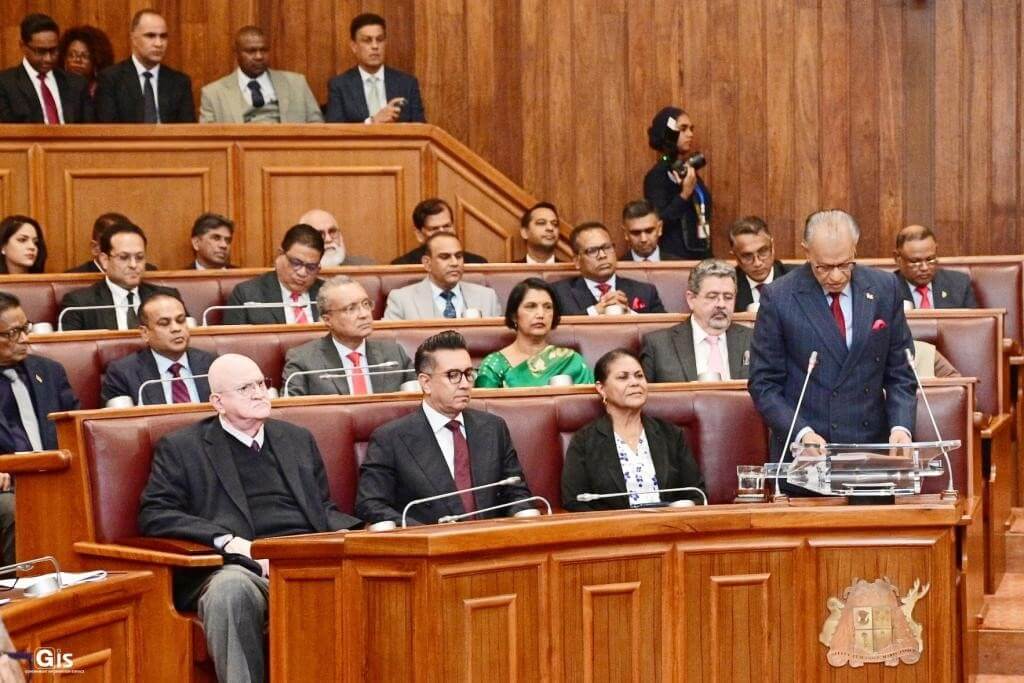
The Minister of Finance presented a budget with no credible capital-markets strategy.
By a digital finance specialist
Paragraph 61 of the Budget Speech makes a sensible promise: clear rules for stablecoins, asset tokenisation, and data-sharing between banks and fintechs. Yet the only measure actually enacted in the Annex names MINDEX Limited as an official exchange and MINDEX Clearing as the country’s official clearing house under the Securities Act. The promised rules — who issues the stablecoin, what backs it, what role the central bank plays — are left entirely undefined, while one private company is written into primary law. No serious jurisdiction — the US, the EU, Switzerland, Singapore, the UAE, the UK — has written a single private exchange into its digital-finance legislation. As with the pension reforms, this is confident aspiration built on poor judgement and no consultation with credible market participants.
The broken plumbing of Mauritius’s capital markets
Before anything can be tokenised, Mauritius must fix the plumbing of its own capital markets — plumbing that has been leaking for years. Our FX market is chronically dysfunctional: the rupee trades at three divergent rates — official, offshore and money-changer — which no credible financial centre can tolerate. The money market is equally distorted: a broad-money overhang approaching MUR 1 trillion and structural excess liquidity that the Bank of Mauritius has never been able to drain, distorting how interest rates work across the entire financial system. Settlement still runs at T+2, meaning cash is locked up for two days after every trade — slow, costly, and most damaging in the fragmented local bond market. Is the same BoM — unable to stabilise the rupee, unable to drain excess liquidity, with no published plan for digital cash — now to oversee real-time settlement of tokenised assets?
Tokenisation can sharpen price discovery and widen access to markets. But it does not create liquidity where none exists. The plumbing must come first.
MINDEX: not the venue you write into the Securities Act
A real exchange is built on three things: trust, deep liquidity, and a strong balance sheet backed by credible sponsors. Consider OKX — one of the world’s largest digital-asset exchanges, consistently trading billions of dollars a day, incorporated in Seychelles, our smaller neighbour. OKX has just formed a 50-50 venture with ICE, owner of the New York Stock Exchange, reaching 120 million users worldwide. That is what a credible, liquid venue looks like — chosen as a partner by the global financial establishment because of its scale, technology and
institutional reach.
MINDEX is not such a venue. From September 2023 to October 2024, its CEO reported total turnover of roughly USD 50 million — a figure OKX exceeds in minutes. On MINDEX’s website you find a static product list and an invitation to email the team to execute a trade. Despite its FSC licences, just one tokenised asset appears on the site. This will not attract institutional investors. Global asset managers and investment banks go where the liquidity, the technology and the track record are — not where a government has inserted a name into
a statute.
Its stated strategy is to tokenise African assets. But African capital markets are fragmented: capital controls, non-convertible currencies, sovereign defaults, chronic dollar shortages. Today, only about USD 32 billion of assets are tokenised globally, alongside around
USD 300 billion in stablecoins — and that value pools where capital markets are deepest and hardest currencies flow freely: the US, Europe and Asia, not Africa. Scale follows liquidity, not legislation.
A conflict of interest nobody is talking about
Naming one private company in primary legislation raises a question of transparency and public interest: who was consulted, who approved this, and why was one firm chosen without any open or competitive process? It goes to the heart of how public trust is built or destroyed.
When a private company’s commercial interests align so closely with a legislative outcome — reached without consultation, without an RFP, and without published justification — the perception of conflict of interest is real and damaging. We have seen this pattern before. The pension reform reversed in Parliament days after it was announced suffered from exactly the same flaw: conflicted people making decisions that affected the public, without transparency. This government repeatedly trusts conflicted people and institutions over open, competitive processes. Every time, the result is the same: private interests dressed in the language of public ambition. Mauritians have a right to ask who benefits — and why nobody is required to say.
Clearing: systemic infrastructure handed without a tender
A clearing house is the institution that guarantees every trade settles and holds the legal register of who owns what. The clearers that handle both digital and traditional assets — such as DTCC in the United States — are owned by the world’s major banks, carry the highest credit ratings, and have been tested over decades. What makes them trusted is not a law: it is their track record, their balance sheet and the credibility of their sponsors. MINDEX Clearing has none of these.
Appointing systemic public infrastructure is a procurement decision, not a drafting exercise. It demands an open tender so that the most credible operator wins on merit — not a statutory clause awarding the role to one firm whose accounts are not even published.
The world builds the cash layer first — Mauritius does the reverse
The Bank of England has made the sequencing explicit in its draft rules for stablecoin issuers: digital cash — backed by short-dated government debt and central-bank deposits — must come first. Only once the settlement asset is safe, regulated and trusted can you build exchanges, clearers and tokenised products on top of it. The United States with the GENIUS Act and the European Union with MiCAR followed exactly the same logic. None of them named a private company in a statute along the way.
Mauritius is doing the reverse. A private venue and clearing arm are now in the Securities Act, but the stablecoin rules, the settlement asset, the central bank’s role — none of it exists. The New York Stock Exchange is building 24/7 tokenised equity trading, but the NYSE earns that position through deep liquidity and decades of institutional trust. Tokenisation follows liquidity. It does not conjure it.
A Ministry that does not understand the markets it is legislating for
The Minister of Finance presented a budget with no credible capital-markets strategy. His junior minister cited USD 4 trillion as the African pension opportunity waiting to flow into Mauritius. The credible figure is USD 500–700 billion — and even that is not free capital. It is locked behind capital controls, non-convertible currencies and sovereign risk. That gap is not a rounding error. It reflects a fundamental misunderstanding of the markets they are legislating for. Grand numbers are not a substitute for market knowledge.
The Bank of Mauritius, meanwhile, has published nothing on digital cash or stablecoins — unsurprising from an institution gripped by its own leadership and institutional crisis. Without the central bank leading on the settlement asset, everything else is built on sand.
What should happen instead
The Bank of Mauritius must fix what is broken: address the excess liquidity distorting money markets, tackle the fragmented FX market, and move settlement to real time. Then the BoM and FSC should publish a joint consultation on digital cash with key stakeholders — the regulated settlement asset that any serious tokenisation framework requires. Appointing a clearer should come only after that consultation and a proper testing phase.
Mauritians deserve policy made with rigour, transparency and genuine expertise — not measures drafted without consultation by unelected, conflicted people, handed to firms without open process, and announced without a strategy. Get the sequence wrong, and Mauritius will not build a credible digital-finance future. It will merely confirm that grand ambition and poor execution are becoming a habit for this government.