
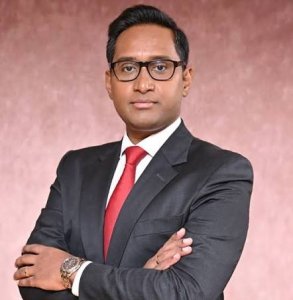
Rajeev Hasnah sits on too many committees.
By J. Banker
The same official guards the currency, chairs the state bailout fund and helps invest the nation’s pensions — in the very banks his central bank regulates. No serious country allows it.
Mauritius is reforming its old-age pension system, and a troubling pattern runs through it: those shaping the rules too often have a stake on the other side. The sharpest of these conflicts is written into no budget. It sits inside the Bank of Mauritius, it bears directly on every citizen’s savings, and it is real and structural.
The First Deputy Governor of the Bank of Mauritius, Rajeev Hasnah, chairs the Mauritius Investment Corporation, the state’s bailout fund, while also sitting on the investment committee of the National Pensions Fund. On its own, that pairing is awkward. What makes it indefensible is what the NPF holds: it is the largest single shareholder of MCB Group, and — after the Government — among the largest of the state-founded SBM, the two systemic banks the Bank of Mauritius licenses and supervises. So, the deputy who runs the Bank’s market operations and financial stability also helps decide how the nation’s retirement money is invested in the very banks his central bank polices.
The lines cross at every turn. The MIC he chairs has financed companies — large hotels among them — in sectors where the NPF holds shares and bonds. The fund invests offshore, and the dollars it needs are rationed by the illiquid FX market he manages. It holds government bonds issued and managed by the Bank of Mauritius, which acts as the government’s debt management office. Regulator, currency-gatekeeper, bailout-fund chairman, pension-fund steward — four roles folded into one chair. Only an explicit, public mandate for the Bank or the MIC to manage NPF money could make such an overlap legitimate. None exists. This is not delegation; it is accumulation.
Global best practice paints a very different picture. Japan’s Government Pension Investment Fund, the largest pension fund on earth, is an independent agency run by its own board of outside experts; no Bank of Japan governor, deputy governor or official sits on it. South Africa entrusts the Government Employees Pension Fund to the Public Investment Corporation, Africa’s largest asset manager, kept firmly segregated from the South African Reserve Bank — no Reserve Bank governor or deputy sits on its board or investment committee. Australia walls its Future Fund, run by independent guardians, off from the Reserve Bank. And Norway, the rare case where the central bank does manage the national fund, does so only under a written mandate from the Ministry of Finance, through a ring-fenced arm separated from monetary policy — and, crucially, the fund invests only abroad, never in Norwegian companies, precisely so the central bank never owns the firms and banks it regulates. The First Deputy Governor, a CFA charterholder trained to treat conflicts of interest as a duty to avoid or fully manage, should grasp the problem at a glance.
Governance decides how well a fund invests and grows
And governance is not abstract; it decides how well a fund invests and grows. Australia’s superannuation funds, run on these arm’s-length principles, have delivered low double-digit returns over the cycle — gains that compound, over a career, into a comfortable retirement. The NPF has done nothing of the sort; its returns have been poor for the better part of seven years, and a few points a year, compounded over decades, decide whether a fund can pay pensions at all. Yet this is the lever the government ignores: its reform squeezed the liability side — eligibility, means tests, contributions — while the asset side, where returns are made, is ignored by policymakers and the expert committee. That is the blunder beneath the blunder, and it is hard to fix when the fund’s investment committee includes a man who, before joining the Bank of Mauritius, had never worked in banking, global markets or official institutions, but came from the finance department of an industrial company. He supplies conflict, not competence — and ordinary savers pay the difference.
The government’s only answer has been a shrug. Asked in Parliament whether these conflicts had been vetted, the Prime Minister — who also holds the finance portfolio — replied that this is a small country, and that “everybody has a conflict of interest in the country.” Yet that is where serious oversight begins, not where it ends.
Nor is the Bank itself sound enough to carry the doubt. Structural excess liquidity has impaired monetary policy transmission; foreign currency has been chronically short since 2020, draining confidence in the rupee; banking supervision is, by widespread account, in disarray; and the Mauritius Investment Corporation (MIC) has still not been wound down, with no forensic audit. The deputy was also the surviving third of the “dream team” that collapsed within months, its Governor — Rama Sithanen — forced out amid a nepotism scandal over his son’s alleged interference in bank licensing and recruitment, claims denied and unproven. When Sithanen went, the honourable course was to leave with him; he stayed, for the office and its privileges. Now he is reportedly backing a bid by Sithanen’s son for the Maradiva resort, in which his own MIC is a major creditor.
A pension fund belongs to the people who paid into it; a central bank belongs to the public. Neither can be safeguarded by one man seated on every side of the table.