
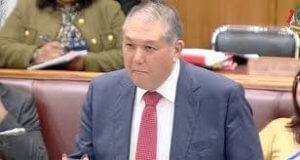
Michael Sik Yuen giving half-explanations on the 28th of April about the HFO contract with Sahara Energy Resource Limited.
By a financial observer
The State Trading Corporation has a troubling habit of awarding critical fuel contracts to obscure, under-capitalised, and in some cases sanctioned traders — while the world’s most capable energy trading houses, including one already operating in Mauritius, are apparently not even considered. In the middle of the worst oil supply crisis since the 1980s, this is not just poor procurement. It is a national and energy security failure.
Every Mauritian should know this number: 45 percent. That is the share of the country’s electricity generated from imported Heavy Fuel Oil (HFO). Mauritius has no oil wells, no refineries, and no strategic petroleum reserve. Roughly 300,000 metric tonnes arrive by tanker each year to power the CEB’s turbines. When the STC signs a fuel contract, it is deciding whether the lights stay on and how much every household pays for electricity.
On April 28, Opposition Leader Joe Lesjongard demanded answers in Parliament. Commerce Minister Michaël Sik Yuen disclosed what had been kept confidential: the contract went to Sahara Energy Resource Limited, registered as a shell company in Douglas, Isle of Man. The premium — the margin above HFO benchmark prices covering freight, insurance, supplier profit, and potentially other hidden costs and intermediary fees — had jumped from $69.80 per metric tonne under the previous supplier to $97.90. That 40 percent increase adds nearly one billion rupees in additional cost. When asked about payments to an Isle of Man account, the Minister said he was not aware of the details.
Does the STC lack the expertise to assess counterparty credit quality and sanctions exposure — or are these choices made deliberately? Who is really benefiting, and are there intermediaries profiting from these deals?
The companies Mauritius should be dealing with
Five firms dominate global physical oil and HFO trading: Vitol, Trafigura, Glencore, Mercuria, and Macquarie. Each operates around the clock across every major hub — London, Rotterdam, Dubai, Singapore, Houston, New York — commanding vast networks of vessels, refineries, and storage terminals, with the financial firepower to move energy from any point on earth to any other, twenty-four hours a day. Vitol trades over seven million barrels daily. Trafigura — rated BBB by S&P — generates $240 billion in annual revenue. Glencore, rated BBB+/Baa1 and listed on the London Stock Exchange at £66 billion, is fully audited and counts the Qatar Investment Authority as a major anchor shareholder. Mercuria has a $55 billion credit facility backed by 130 banks. Macquarie, rated A+/Aa2 with a $300 billion balance sheet, was named Oil and Products House of the Year 2025 by the prestigious Energy Risk publication. Sahara trades roughly 80 million barrels of crude per year. Vitol moves that volume in ten days. They are not in the same category.
Trafigura and Glencore have faced controversies in Africa — political investigations, environmental incidents. But they remain the largest trading houses on earth, with the credit quality and risk management a sovereign buyer requires. The answer is transparent contracts and robust oversight — not retreating to obscure regional players with weak balance sheets and no credit rating.
Why only the best can trade HFO — and what really explains the premium
HFO sits at the very bottom of the refinery barrel — thick as treacle, high in sulphur, and chemically different depending on which refinery produced it. Unlike crude oil or gasoline, its pricing requires deep physical market knowledge, not just a data screen. Every cargo demands specialist expertise in its origin, its blend specification, and how to deliver it to the buyer’s exact requirements. It is the most technically demanding product in the energy trading universe, and the least liquid: very few firms actively trade it, a single large cargo can move prices, and there are no deep financial markets to absorb the risk.
To trade HFO competitively, a firm needs four things simultaneously. First, physical storage at the world’s major bunkering ports — Singapore, Rotterdam, Houston — to hold and blend inventory. Without storage, you are not a market maker; you are a middleman. Second, long-term agreements directly with refineries, securing barrels at production cost rather than paying open-market prices — a permanent cost advantage no spot buyer can close. Third, a large fleet — Vitol controls some 250 vessels — to fix freight efficiently, especially critical during the Iran war when tanker rates are spiking. Fourth, a live risk management operation that locks in prices the moment a deal is struck, neutralising HFO’s extreme volatility in real time. Macquarie, recognised by the prestigious Energy Risk awards, makes markets across more than 100 oil product indexes simultaneously. That is the standard this market demands.
Credit and balance sheet size are equally decisive. Sahara, unrated and with no public accounts, carries an implied credit quality at or below Nigeria’s own sovereign rating — B− from S&P and B3 from Moody’s, deep in sub-investment grade. For a country as focused on credit ratings as Mauritius, this should have been disqualifying from the outset. Every extra basis point of borrowing cost Sahara faces lands directly in the premium.
The 40 percent premium is therefore not a negotiating failure. It is the structural price of using the wrong supplier. A trader without infrastructure prices risk into the margin. Without investment-grade credit, financing costs are passed on. Without a global refinery network and a 24-hour trading franchise spanning every major hub, a firm is forced to buy at expensive spot prices rather than the competitive gate prices available to the top five houses — a permanent and structural cost disadvantage. And the public deserves answers to a harder question: are there intermediary fees buried in this contract? Undisclosed commissions? A line-by-line breakdown of what that $97.90 premium actually contains has never been provided. Vitol, the world’s largest physical oil trader, already operates in Mauritius. The question is not whether the right firms could have done this. It is why they were apparently never asked.
A deliberate pattern, or dangerous incompetence?
Sahara is not an isolated lapse — it is the third in a troubling sequence. The previous contract went to Coral Energy DMCC, a Dubai trader that quietly renamed itself 2Rivers DMCC before being sanctioned by British authorities in December 2024 as a key node in Russia’s shadow fleet — used to ship sanctioned crude while concealing its origin. Its banking relationships collapsed, and it could no longer deliver despite over 230,000 tonnes already purchased. Before Coral, the STC was exposed to Mercantile & Maritime, the Bahrain-based trader whose founder Murtaza Lakhani was investigated by the US Department of Justice for breaching Russian oil price cap sanctions and subsequently sanctioned by both the EU and UK in December 2025 — described by Bloomberg as a key architect of Russia’s post-invasion sanctions evasion network. Sahara itself is not sanctioned, but it has faced its own reputational clouds: a 2013 Berne Declaration report on opaque Nigerian oil subsidy dealings named it among firms with Geneva shell subsidiaries, and media investigations have alleged over $300 million in bribery connected to the OML 11 oil block — all of which Sahara firmly and categorically denies.
Three consecutive counterparties: a shadow fleet operator sanctioned for Russian sanctions evasion, a founder personally blacklisted by Western authorities, and now a company routing a sovereign fuel contract through an Isle of Man shell company whose payments the commerce minister cannot explain. The pattern is too consistent to dismiss as bad luck. Parliament must ask directly: does the STC lack the expertise to screen counterparty credit quality and sanctions exposure — or are these choices made deliberately, for purposes that remain opaque? Who is really benefiting, and are there intermediaries profiting from these deals?
The worst possible time for the wrong supplier
The IEA has called the Hormuz closure ‘the largest supply disruption in the history of the global oil market since the 1980s.’ Twenty percent of seaborne oil has been cut off. Brent has surged past $110. Mauritius’s petroleum import bill could reach Rs 100 billion — enough to trigger a balance of payments crisis, drain foreign exchange reserves, weaken the rupee, and threaten the sovereign credit rating. When Hormuz closed, Vitol’s Singapore desk sourced alternative Asian barrels, its London desk restructured freight, and its Geneva desk managed the price and risk exposure — simultaneously, within hours. A shell company in the Isle of Man cannot do this. The STC must stop appointing political nominees to its board and replace them with energy market professionals who understand what sovereign procurement actually requires.
Green pledges, dirty fuel
There is a final irony every Mauritian should sit with. Our leaders attend climate conferences. Our policy documents overflow with net-zero pledges. Our private sector and banks star in sustainability campaigns. Luxury electric vehicles are the new status symbol. And yet 45 percent of our electricity is generated by burning heavy fuel oil — the most carbon-intensive, polluting refined product in commercial use, the very one the global shipping industry is desperately racing to eliminate.
The 2025–2026 budget allocated $662 million toward solar and biomass. That is a start — but it does not excuse the contradiction. Are we really decarbonising this economy, as so many of our leaders proclaim? Or are we greenwashing while locking in dependence on the dirtiest fuel on earth, procured through the least transparent process imaginable? The lights must stay on. But they must be powered by the right fuel, bought from the right suppliers, at the right price, and with full accountability and disclosure to the people who pay for it.