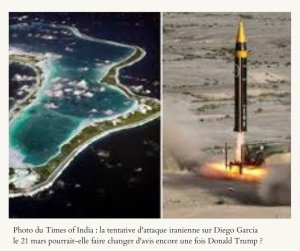
Un Américain qui suit de près l’affaire Chagos attire notre attention sur les points suivants :
1. En vertu de l’Annexe 1 du traité, le gouvernement britannique a le devoir d’informer le gouvernement mauricien « 𝑜𝑓 𝑎𝑛𝑦 𝑎𝑟𝑚𝑒𝑑 𝑎𝑡𝑡𝑎𝑐𝑘 𝑜𝑛 𝑎 𝑡ℎ𝑖𝑟𝑑 𝑆𝑡𝑎𝑡𝑒 𝑑𝑖𝑟𝑒𝑐𝑡𝑙𝑦 𝑒𝑚𝑎𝑛𝑎𝑡𝑖𝑛𝑔 𝑓𝑟𝑜𝑚 𝑡ℎ𝑒 𝐵𝑎𝑠𝑒 𝑜𝑛 𝐷𝑖𝑒𝑔𝑜 𝐺𝑎𝑟𝑐𝑖𝑎 ».
Question : pourquoi Navin Ramgoolam a-t-il, le 17 mars, été vague en déclarant que « 𝑇ℎ𝑒 𝐷𝑖𝑒𝑔𝑜 𝐺𝑎𝑟𝑐𝑖𝑎 𝑏𝑎𝑠𝑒 𝑑𝑜𝑒𝑠 𝑛𝑜𝑡 𝑐𝑜𝑚𝑒 𝑖𝑛𝑡𝑜 𝑝𝑙𝑎𝑦 ℎ𝑒𝑟𝑒 𝑎𝑡 𝑎𝑙𝑙. 𝐴𝑠 𝑓𝑎𝑟 𝑎𝑠 𝐼 𝑘𝑛𝑜𝑤, 𝑡ℎ𝑒 𝐵𝑟𝑖𝑡𝑖𝑠ℎ 𝑔𝑜𝑣𝑒𝑟𝑛𝑚𝑒𝑛𝑡 ℎ𝑎𝑠 𝑛𝑜𝑡 𝑎𝑙𝑙𝑜𝑤𝑒𝑑 𝑡ℎ𝑒 𝑢𝑠𝑒 𝑜𝑓 𝐷𝑖𝑒𝑔𝑜 𝐺𝑎𝑟𝑐𝑖𝑎 – 𝑢𝑝 𝑡𝑜 𝑛𝑜𝑤 ».
2. L’absence de rencontre et d’échange directs entre le président Donald Trump et Navin Ramgoolam pose problème.
The Chagos Deal was negotiated by three outgoing leaders. Washington may now reconsider it in geopolitics, some of the most consequential decisions are often made quietly, far from the public eye. Few places illustrate this better than Diego Garcia, a remote coral atoll in the middle of the Indian Ocean that has played an outsized role in global military strategy for more than half a century.
For decades, Diego Garcia functioned as one of the most reliable strategic anchors in America’s global military network. Yet today, the political framework surrounding this base is undergoing one of the most significant transformations in its history.
In 2025, the United Kingdom and Mauritius signed an agreement transferring sovereignty of the Chagos Archipelago to Mauritius while preserving the joint U.S./UK military base on Diego Garcia for at least 99 years. On the surface, the deal appeared to resolve decades-long sovereignty dispute while maintaining Western security capabilities in the Indian Ocean.
But the timing of the agreement and the political leaders who negotiated it may prove just as important as the agreement itself.
Today, in a dramatically different geopolitical environment, Washington may increasingly reassess the long-term strategic implications of that decision.
𝐓𝐡𝐞 𝐬𝐭𝐫𝐚𝐭𝐞𝐠𝐢𝐜 𝐢𝐬𝐥𝐚𝐧𝐝 𝐟𝐞𝐰 𝐩𝐞𝐨𝐩𝐥𝐞 𝐤𝐧𝐨𝐰 𝐚𝐛𝐨𝐮𝐭
To understand the significance of the Chagos deal, one must first understand the importance of Diego Garcia. Located in the center of the Indian Ocean, the island sits at a strategic crossroads connecting the Middle East, Africa and Asia. From Diego Garcia, U.S. aircraft can reach the Persian Gulf, East Africa and large parts of South Asia without relying on bases located in politically sensitive regions.
Naval logistics fleets have used its harbor to sustain deployments across the Indian Ocean. Intelligence systems have monitored maritime routes through which a large share of global energy supplies travel.
The British government has described the base as a “𝑢𝑛𝑖𝑞𝑢𝑒 𝑠ℎ𝑎𝑟𝑒𝑑 𝑝𝑙𝑎𝑡𝑓𝑜𝑟𝑚 𝑤𝑖𝑡ℎ 𝑖𝑟𝑟𝑒𝑝𝑙𝑎𝑐𝑒𝑎𝑏𝑙𝑒 𝑠𝑒𝑐𝑢𝑟𝑖𝑡𝑦 𝑐𝑎𝑝𝑎𝑏𝑖𝑙𝑖𝑡𝑖𝑒𝑠.” For American defense planners, Diego Garcia is not simply another base. It is a strategic anchor a location that provides reach, security and operational flexibility in one of the most geopolitically important regions of the world.
𝐓𝐡𝐞 𝐫𝐨𝐨𝐭𝐬 𝐨𝐟 𝐭𝐡𝐞 𝐂𝐡𝐚𝐠𝐨𝐬 𝐝𝐢𝐬𝐩𝐮𝐭𝐞
The sovereignty dispute surrounding the Chagos Archipelago dates back to the final years of the British Empire. In 1965, the United Kingdom separated the Chagos islands from the colony of Mauritius prior to Mauritian independence in 1968. The islands were organized as the British Indian Ocean Territory, and Diego Garcia was developed into a joint U.S.–UK military base.
For decades, Mauritius argued that the separation of the islands was unlawful and that sovereignty over the archipelago rightfully belonged to the Mauritian state. The dispute gradually moved from diplomatic negotiations to international legal institutions. In 2019, the International Court of Justice issued an advisory opinion concluding that the decolonization of Mauritius had not been lawfully completed after the separation of the islands.
Although the ruling was not legally binding, it significantly strengthened Mauritius’ diplomatic position. A subsequent United Nations General Assembly resolution supported Mauritius’ claim and increased pressure on the United Kingdom to find a resolution. In the early 2020s, London faced growing international pressure to settle the issue.
𝐀 𝐝𝐞𝐚𝐥 𝐧𝐞𝐠𝐨𝐭𝐢𝐚𝐭𝐞𝐝 𝐛𝐲 𝐭𝐡𝐫𝐞𝐞 𝐨𝐮𝐭𝐠𝐨𝐢𝐧𝐠 𝐥𝐞𝐚𝐝𝐞𝐫𝐬
The eventual settlement came in 2025. Under the agreement, Mauritius would regain sovereignty over the Chagos Archipelago while allowing the United Kingdom to continue operating the Diego Garcia military base with U.S. forces for an initial 99-year period.
Each government involved had strong political incentives to finalize the agreement.
For Prime Minister Rishi Sunak, the deal offered a way to resolve a lingering colonial dispute that had become increasingly difficult to defend diplomatically.
For President Joe Biden, the primary objective was ensuring continuity in U.S. military access to Diego Garcia while avoiding legal uncertainty surrounding the base.
For Mauritian Prime Minister Pravind Jugnauth, the agreement represented a historic diplomatic achievement, restoring sovereignty over territory that had been contested for decades.
But the reality remains that the deal was negotiated under three leaders whose political eras were nearing transition. Generally, agreements concluded during periods of political transition often invite reassessment once new leadership evaluates their strategic implications.
𝐓𝐫𝐮𝐦𝐩’𝐬 𝐞𝐚𝐫𝐥𝐲 𝐫𝐞𝐚𝐜𝐭𝐢𝐨𝐧 𝐭𝐨 𝐭𝐡𝐞 𝐚𝐠𝐫𝐞𝐞𝐦𝐞𝐧𝐭
When Prime Minister Keir Starmer held his first Oval Office meeting with President Donald Trump on February 27, 2025, the Chagos agreement was already part of the transatlantic security discussion. At the time, President Trump indicated that the arrangement appeared to be a “fair deal”, provided that the strategic security of the Diego Garcia base remained protected.
But geopolitical agreements rarely remain static. As military realities evolve, operational planning and strategic priorities can reshape how such agreements are evaluated.
In early 2026, developments in U.S. military planning particularly regarding Middle East contingencies have prompted renewed scrutiny of the treaty’s operational implications.
𝐓𝐡𝐞 𝐧𝐨𝐭𝐢𝐟𝐢𝐜𝐚𝐭𝐢𝐨𝐧 𝐜𝐥𝐚𝐮𝐬𝐞 𝐚𝐧𝐝 𝐬𝐭𝐫𝐚𝐭𝐞𝐠𝐢𝐜 𝐟𝐥𝐞𝐱𝐢𝐛𝐢𝐥𝐢𝐭𝐲
One provision of the agreement has drawn particular attention among defense analysts. The treaty requires the United Kingdom to inform Mauritius if an armed attack against a third state is launched from Diego Garcia.
The clause does not give Mauritius the authority to block military operations. However, it introduces a diplomatic notification step that did not previously exist.
For a base historically valued for operational discretion, even modest diplomatic procedures may introduce additional political considerations during sensitive military operations.
Three clauses that could shape future military planning
Beyond the notification provision, several other clauses may have broader long-term implications.
First, the treaty introduces elements of shared governance across parts of the archipelago, meaning certain activities outside the immediate base area require consultation between the United Kingdom and Mauritius.
Second, Mauritius retains regulatory authority over developments on the outer islands of the Chagos Archipelago, meaning infrastructure or installations outside Diego Garcia could fall under Mauritian oversight.
Third, the agreement establishes coordination zones around Diego Garcia, requiring government-to-government consultation for certain maritime or infrastructure activities near the base.
Individually, these provisions may appear administrative. Collectively, they introduce an additional governance layer around one of the United States’ most strategically important military installations.
𝐀 𝐜𝐡𝐚𝐧𝐠𝐢𝐧𝐠 𝐝𝐢𝐩𝐥𝐨𝐦𝐚𝐭𝐢𝐜 𝐥𝐚𝐧𝐝𝐬𝐜𝐚𝐩𝐞
Another factor shaping the strategic outlook is the evolving diplomatic relationship surrounding the agreement. While U.K. Prime Minister Keir Starmer has already met with President Donald Trump at the White House, the same level of direct engagement has not yet occurred between President Trump and Mauritian Prime Minister Navinchandra Ramgoolam.
Although diplomatic communication between the United States and Mauritius continues through traditional channels, the current Mauritian leadership was not directly involved in negotiating the original Chagos agreement, which was concluded under former Prime Minister Pravind Jugnauth. This creates a notable geopolitical dynamic: a critical Western military installation now operates within the sovereign territory of a government that did not participate in shaping the treaty that governs it.
A direct meeting between President Trump and Prime Minister Ramgoolam could therefore provide an opportunity to clarify strategic expectations, strengthen bilateral trust, and potentially refine elements of the agreement as implementation continues. Such engagement may also prove timely given that financial commitments associated with the treaty framework were expected to begin around May 2026, making high-level dialogue particularly important as both governments consider the long-term strategic structure of the arrangement.
𝐒𝐨…
The Chagos agreement was designed to close a colonial-era dispute while preserving the strategic value of Diego Garcia. Yet the circumstances surrounding its negotiation, under three outgoing leaders: Rishi Sunak, Joe Biden and Pravind Jugnauth have placed the treaty within a rapidly evolving geopolitical landscape.
As military planning, alliance dynamics and political leadership change, agreements crafted under one set of assumptions are often revisited under another. For Washington, the question is no longer simply whether the base will remain operational, but whether the governance framework surrounding it provides the strategic clarity and flexibility required for future military operations.
Diego Garcia has long been one of America’s most dependable strategic platforms. Whether the current framework strengthens or complicates that role will likely shape the next chapter of the Chagos story not only for Mauritius and the United Kingdom, but for U.S. global military strategy as well.